


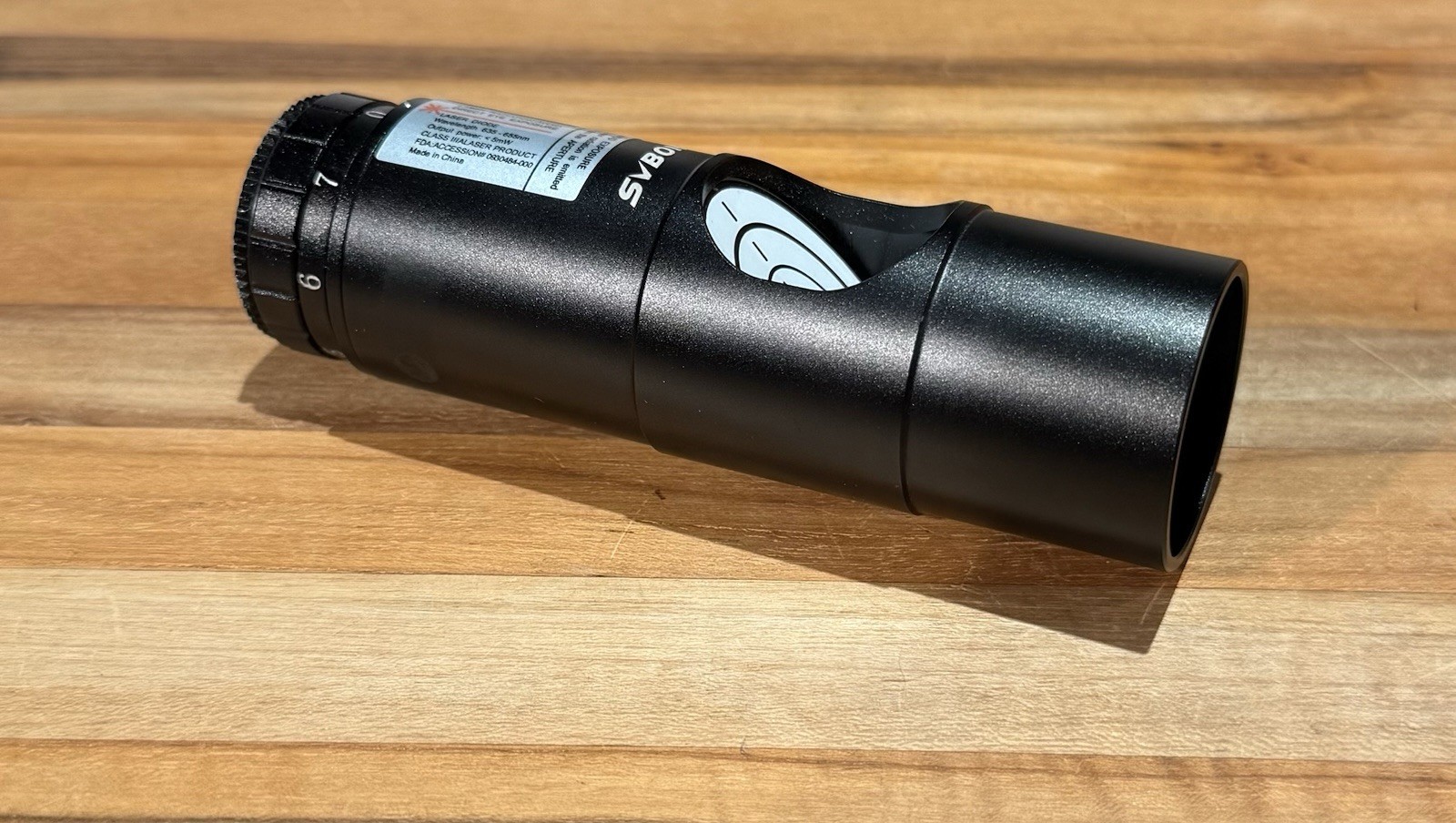


SVBONY telescope reflector eyepiece Next Generation Laser Collimator 1.25-inch
$ 0.53
Description
SVBONY telescope reflector eyepiece Next Generation Laser Collimator 1.25-inch. It is nearly complete to code, missing only the original print instructions. This Next Generation Laser Collimator (NGLC) laser seen here is the 1st gen model SVBONY released back as far as 2018 (farthest back years I can prove) and ran until just last year (2025). This auction is for a 2020 SVBONY (very highly likely from Elite Optoelectronics of China) 1.25-inch Next Generation Laser Collimator. It is nearly complete to code, missing only the original print instructions. It will come with the laser unit with a fresh battery already installed, the 2-inch to 1.25-inch aluminum focuser adapter with large setscrew, and the original box with inner foam mold. **For my foreign friends, you need to make sure YOUR COUNTRY will allow this laser to be delivered to your region's postal station. This is a Class IIIA laser. Some nations will not allow their citizens to even own red dot lasers, which this unit operates with. So, for your convenience, make sure prior to bidding that this will make it through your nation's customs.** This Next Generation Laser Collimator (NGLC) laser seen here is the 1st gen model SVBONY released back as far as 2018 (farthest back years I can prove) and ran until just last year (2025). It is the exact same model as the Orion 4th gen LaserMate Deluxe (2006-2011), which was well-received for its updated, cemented lens alignment process for the laser itself, made shorter, and lighter in weight, and because of the bullseye, reflective return grid, the need of having a centering mark on the primary mirror is no longer required. However, these variants of laser collimators had slight issues being properly situated in the focuser adapter due to the elimination of the large "resting ring"; a large, bulky, protruding portion of the body that assisted in centering weight distribution equally in the focuser. When the manufacturers updated the design to eliminated this resting ring, confirmation of the collimator's position parallel to the focuser's mechanical axis was now jeopardized. To mitigate this problem, back in the day and before reversing the design by creating the LaserMate Deluxe II, Orion released their Precision Centering Adapter (mpn 52024). This ring held eyepieces and laser collimators without the aid of a single or dual setscrew, and, when turned, "squeezes" the barrel of the inserted accessory equally on all quadrants; resulting in a properly centered eyepiece in said focuser. Takahashi and their use of compression adapter tubes in their focusers, turrets, diagonals, and reducer/amplifier lenses are the original centering rings, which were in use decades before laser collimation were even a concept. Proper centering of a laser collimator in your focuser is a crucial step in accurately collimating your reflector's mirrors because even is the laser illuminator unit itself is absolutely dead-centered aligned in the laser collimator housing, if the entire laser collimator eyepiece is slightly off-angled when positioned in the focuser itself, the entire process of laser collimation is now erroneous. So, below is a little table for you to use when going about inserting this SVBONY laser collimator into your reflector focuser: * Single setscrew: not reliable for true centering with the focuser. Will work in f/6 and longer reflectors for most visual fixes of misalignment at the primary mirror. * Single setscrew uses inner compression ring: far more reliable than above, yet will still apply more pressure on the screw side than the opposing side. * Dual setscrews: reliable, but make sure there is equal travel distance used in both setscrews to contact the barrel of the collimator. * Dual setscrew uses inner compression ring: even more reliable than above. Just make sure you give it a gentle wiggle to make sure there is no looseness. * 3-triangulated setscrews: very reliable as long as each screw was turned an equal number of times to contact the collimator barrel. Back in the day, this was the most precise practice. * Compression ring/centering eyepiece adapter: Best possible method for eliminating any errors of alignment from the insertion process. Equal pressure and contact will be applied in all quadrants. If your focuser is basic and you want it to use a true centering eyepiece adapter in tangent with the SVBONY NGLC, get one of these; keep in mind these ALL require a 2-inch focuser: Antares Twist-lock Adapter Astromania Twist-Lock Eyepiece Adapter Founder Optics Twist Lock Self Centering Eyepiece Adapter Orion Precision Centering Adapter Model: Next Generation Laser Collimator 1.25-inch Barrel size: 1.25-inch Fits in: 1.25-inch reflector focusers or 2-inch with 1.25-inch adapter Design: triple-cemented lens aligned 5-milliwatt laser encased in relay tube with reflective grid Purpose: project laser relay to measure degree of miscollimation Laser wavelength: 635 to 655 nanometers Power source: (1) CR2032/DL2032 battery Operating power: 3 volts Battery life: 3 hours total Laser brilliance adjustable: yes, 7-levels of brightness Total body length: 4.10-inches Materials: milled anodized aluminum, steel Weight with batteries installed: 3.0 ounces When it is time to change the single, 3-volt button battery, locate the top of the collimator, which will have a large slot running across; that is the cap for the battery compartment. If you cannot loosen it with your fingers, you can place a quarter (coin) in the slot and give it a gentle counterclockwise turn. When placing in the new battery, make sure it is smooth-side pointed upwards. Then, tighten the cap clockwise and your all set. To operate, once the laser is secured in your focuser, grip the top portion of the laser unit. Here, you will see numbers "0" to "7". These are brightness indicators; the larger the number, the brighter your laser will be. Keep in mind, the brighter the laser, the quicker you will drain your battery. Just below the ring of numbers, you will see a single, tiny, silver dot. The dot indicates the current brightness factor being used. If it is set to "0", the laser is turned off. The grip knob will turn in either direction. This auction ad was completely, organically written by Veradale Mobile Observatory, not an A.I. software device; an actual honest-to-goodness, real human with over 20 years experience with now over 1000 telescopes made from today and all the way back to 1948. Packed with great care so that you get the box exactly as you see it now.